
Digital Subscription Cancellation Rate by Age Group in Germany — Q1 2024 to Q1 2026
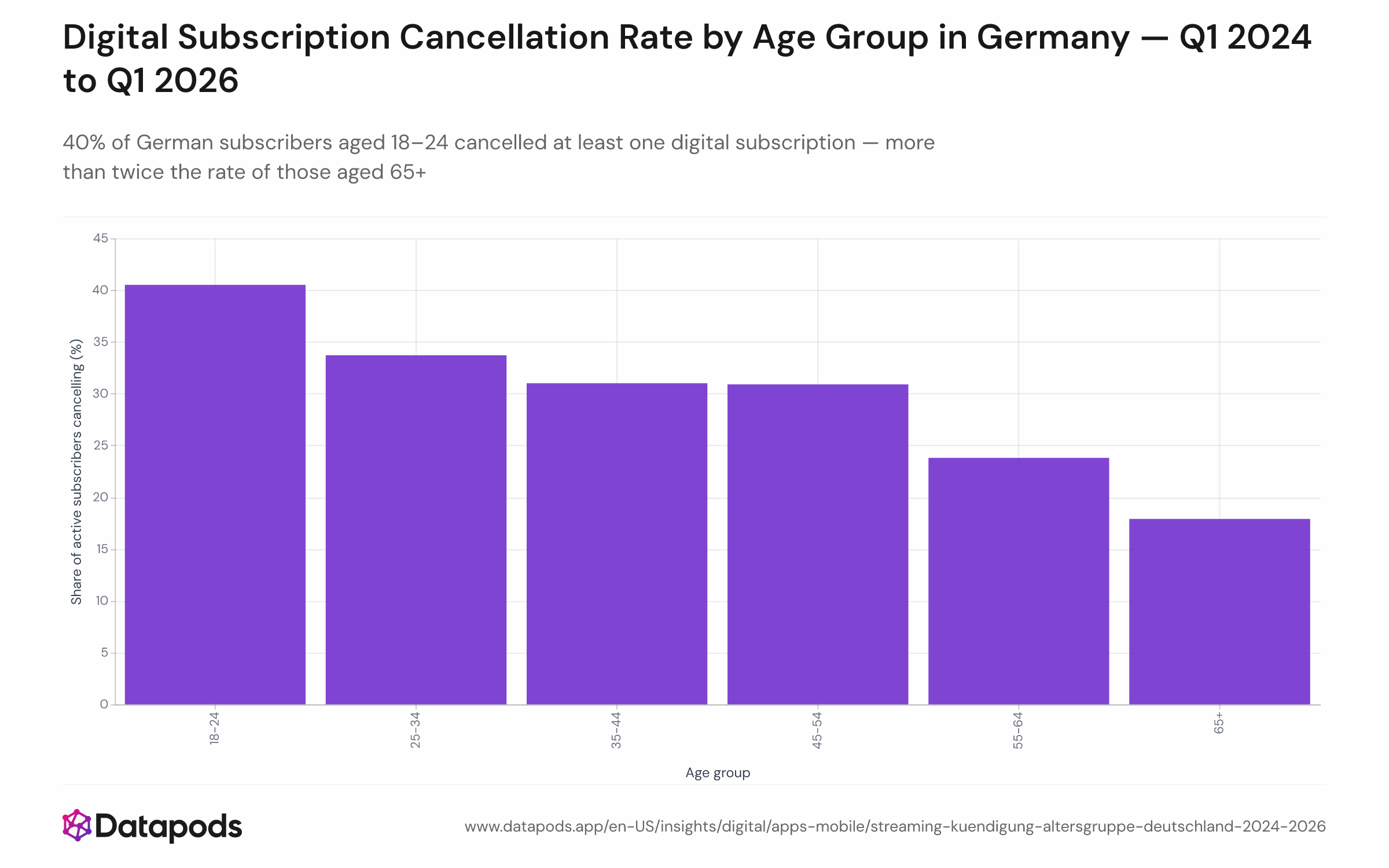
Review Q1 2024 – Q1 2026: 40% of German subscribers aged 18–24 cancelled at least one digital subscription — more than twice the rate of those aged 65+
Info
- Sample size
- n = 5,800
- Data date
- Q1 2024 – Q1 2026
- Segment
- 16-24, 25-34, 35-44, 45-54, 55+
- Platform
- Receipts, Survey
- Market
- Germany
Analysis
The share of active German digital subscribers who cancelled at least one service between Q1 2024 and Q1 2026 drops monotonically with age: 40% for the 18–24 cohort, roughly 31% for 35–54-year-olds, and just 18% for those aged 65 and over.
Why younger subscribers cancel more — and differently
The age gradient reflects two distinct behavioural patterns. Younger subscribers treat streaming subscriptions as episodic commitments: international research consistently finds that the majority of Gen Z subscribers sign up to watch a specific show and cancel once it ends. With streaming content now scattered across six or more competing platforms in Germany, this churn-and-rejoin cycle is actively accelerating. Older subscribers, by contrast, tend to retain fewer services but keep them year-round. The German market context reinforces this: the average German household manages between 8 and 12 active subscriptions, and younger cohorts — carrying the largest portfolio — face the most acute subscription fatigue. For streaming services, the implication is clear: retention strategies designed for a 50-year-old viewer will not work for a 22-year-old.
This analysis is based on public segment data. For deeper cuts, use our Enterprise interface.
Methodology
The cancellation rate is calculated as the share of active German digital subscribers in each age group who received at least one confirmed subscription cancellation email between Q1 2024 and Q1 2026. Age is based on self-reported birth year. The denominator is all subscribers with any active subscription event during the same window. Age groups covered are 18–24, 25–34, 35–54, 55–64, and 65+. The gradient is reported as a within-cohort comparison and does not adjust for differences in portfolio size across age groups.