
Streaming Cancellation Rate vs. GfK Consumer Climate in Germany — February 2024 to December 2025
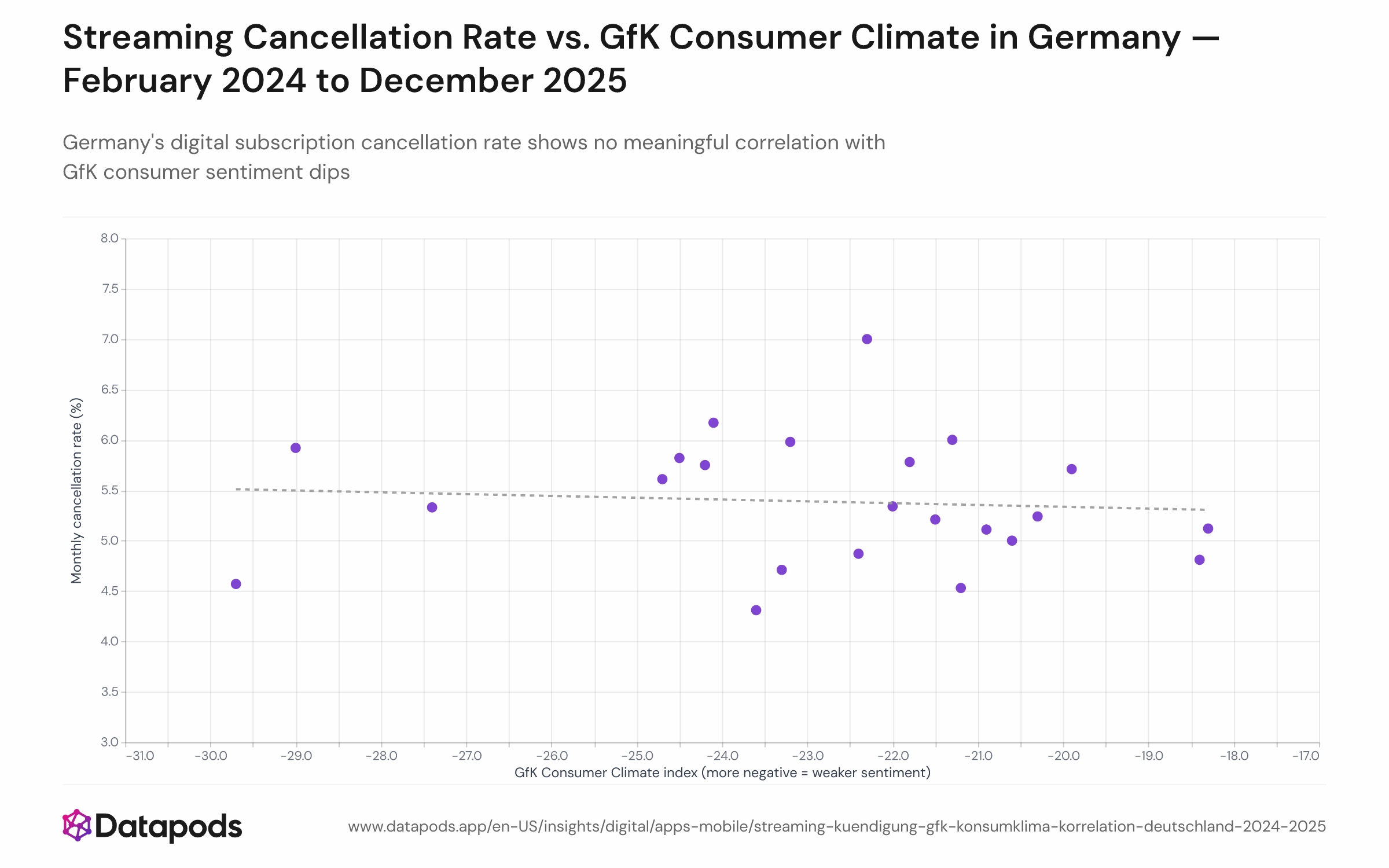
Review Feb 2024 – Dec 2025: Germany's digital subscription cancellation rate shows no meaningful correlation with GfK consumer sentiment dips
Info
- Sample size
- n = 2,541
- Data date
- Feb 2024 – Dec 2025
- Segment
- All segments
- Platform
- Market
- Germany
Analysis
The intuitive hypothesis that Germans cancel digital subscriptions in greater numbers when consumer sentiment falls does not hold in the data: the monthly digital-subscription cancellation rate and the GfK Consumer Climate index move independently across February 2024 through December 2025, with the worst sentiment months sitting squarely in the middle of the cancellation distribution.
What drives subscription churn — and what doesn't
The GfK Consumer Climate index remained deeply negative throughout the observation window, fluctuating between roughly -20 and -29 without ever recovering to positive territory, as persistent inflation fears, weak income expectations, and a record-high savings propensity kept German household confidence subdued. Yet that sustained pessimism does not translate into subscription cancellation spikes — the cancellation rate tracks a different rhythm, driven instead by platform-specific events such as pricing changes and content shifts rather than macroeconomic mood. This decoupling has practical implications: subscription churn in Germany appears to be a product-quality and price-value decision, not a broad belt-tightening reflex. Campaigns that frame subscriptions as discretionary cuts during tough economic times are likely to misread the actual cancellation driver.
This analysis is based on public segment data. For deeper cuts, use our Enterprise interface.
Methodology
The scatter plot covers 23 months from February 2024 to December 2025. The monthly subscription cancellation rate is the share of active German digital subscribers who cancelled at least one service in the given month. The GfK Consumer Climate index values are the official monthly readings published jointly by NIQ/GfK and the Nuremberg Institute for Market Decisions (NIM). January 2026 onwards is excluded from this analysis to isolate the underlying behavioural trend from an end-of-period base expansion.