
TikTok Shop Category Reach Among German Shoppers — Q1 2026
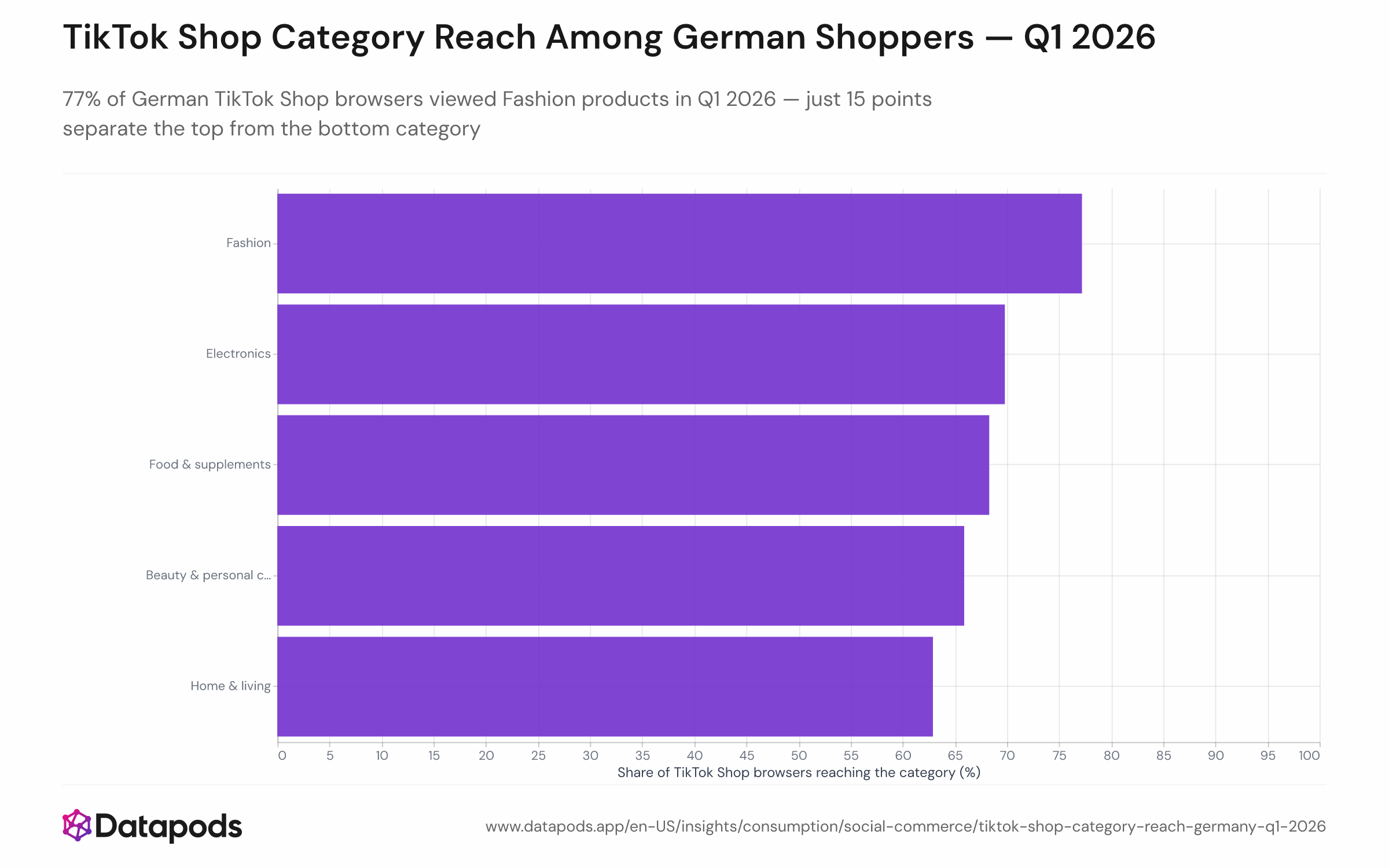
Review Q1 2026: 77% of German TikTok Shop browsers viewed Fashion products in Q1 2026 — just 15 points separate the top from the bottom category
Info
- Sample size
- n = 5,201
- Data date
- Q1 2026
- Segment
- All segments
- Platform
- TikTok
- Market
- Germany
Analysis
Fashion is the most-browsed TikTok Shop category in Germany, with 77% of in-app shoppers viewing clothing or accessories in Q1 2026 — yet the overall category spread is remarkably tight, with Electronics (70%), Food & supplements (68%), Beauty (66%), and Home & living (63%) all within 15 percentage points of the leader.
Why Germany isn't just a Fashion or Beauty play
Conventional assumptions about TikTok Shop — informed by its global reputation as a beauty-and-accessories channel and by the brands that launched with it in Germany, including ABOUT YOU and NIVEA — do not fully hold in the German market. One year after the March 31, 2025 launch, TikTok Shop Germany has rapidly become a general-purpose discovery channel: the typical browser explored 3–4 distinct categories in a single quarter. Electronics over-indexes among 45–54-year-olds, while Beauty skews toward under-35s, suggesting that category reach is shaped as much by audience age as by platform aesthetics. The narrow category gap means that brands outside fashion and beauty are finding genuinely comparable audiences on TikTok Shop — a signal that social commerce trends in Germany are maturing faster than many observers expected.
This analysis is based on public segment data. For deeper cuts, use our Enterprise interface.
Methodology
The chart covers 5,201 German TikTok users who browsed at least one TikTok Shop product during Q1 2026 (January–March). Category reach is measured as the share of this group who viewed at least one product in each of five categories — Fashion, Electronics, Food & supplements, Beauty & personal care, and Home & living — during the quarter. Because shoppers can browse multiple categories, shares add up to more than 100%. A small share of products with ambiguous category signals (novelty items, multi-category goods) are excluded; all five reported categories are based on the remaining classified browsing activity.